

Shooting the Milky Way
The weather was accommodating in August, so we went out to capture the stars.
The weather was accommodating in August, so we went out to capture the stars.
It was August. The nights had been clear and were predicted to remain clear into September. Unusual for the Pacific Northwet. There were some moonless evenings approaching — makes for great opportunities for star photography.
I consulted PhotoPills, an App that gives lots of useful information to a photographer. I learned that the Milky Way would be visible in the late evening and would be vertical between eleven and midnight — 😎.
My first thought was Mt Rainier National Park. The Sunrise area offers great views of the southern skies. The lights from Seattle — Tacoma are blocked by the mountain. But what to use for a foreground?
My friend Trinda had published a great photo earlier in the year with the Milky Way erupting out of Mt St Helens. Her shot was from somewhere along Highway 504, the road up to the Johnson Observatory. This put her composition viewing the mountain from the west. The Milky Way was in the east at that time. Now, in August, the Milky Way was in the west.
Back to PhotoPills. If I were to go to Windy Ridge, a less popular lookout on the northeast corner of the mountain, I could get the Milky Way / Mt St Helens alignment I was looking for.
First attempt
I called my friend Larry. “Want to go shoot the Milky Way? Going to drive down to Windy Ridge on Wednesday afternoon.”
Windy Ridge is accessed via National Forest Roads. They are paved… Mostly… Google Maps did a masterful job of misdirecting us onto a lesser maintained more white-knuckle road than FR 25 to FR 99. Princess Prius got Larry, Liddy, and I there, but I think I added some indents to the steering wheel.
We got some good shots from the Windy Ridge parking lot and called it a night. Our drive home, on the recommended route, FR25, was only slightly less stressful than the drive in. It’s hard to see those car devouring frost heaves on the forest road on most nights let alone a moonless one.
More research required
On reviewing the collection from the trip, I was disappointed. Lots of noise, too dark, too bright, too many other issues. Not very good. Not very productive. Not very satisfying. More research required.
PhotoPills provides some great tutorials on YouTube. So does Alyn Wallace. Alyn recommends Sequator for Windows users as a tool to stack multiple star shots. With this tool you can brighten the composition and remove noise. I took notes.
New plan
A few days later, Liddy and I were again headed to Windy Ridge. This time I was prepared to spend the night having configured Princess Prius into RV mode. I also planned to climb to the top of Windy Ridge to get a better perspective on the galactic core.
Arriving at the parking lot without incident, Liddy and I prepared for the climb — lots of stairs — up the ridge. Climbs like this are a challenge for me, but we are determined.
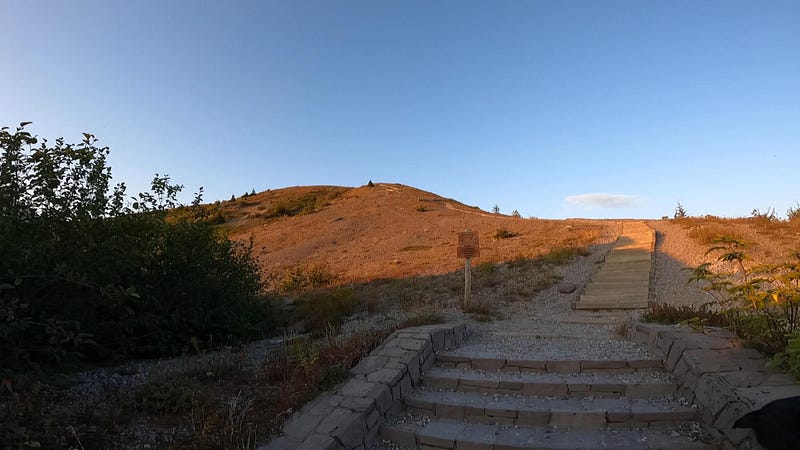
We did not achieve the viewpoint on the ridgetop. I had only huffed and puffed my way to the first or second landing when I declared a halt. I would have pressed on, but the sunset was… Well, the sunset was stunning!

My star photography research also payed off. The shot that I wanted would happen between eleven and midnight, so I had lots of time to practice with time exposures and getting the ISO settings right.
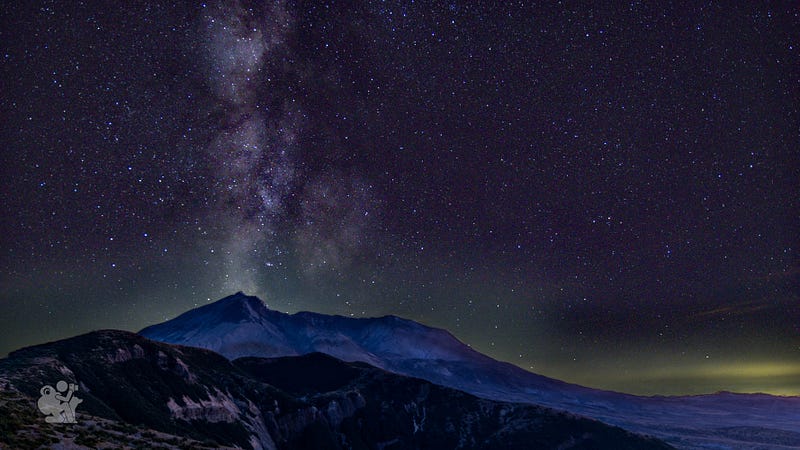
Once my tripod was set and the composition framed, I took a shot of the mountain while there was still some light on the mountainside. This shot would be used to fill in the foreground. Then I shot sets of exposures at f/4.0, 8 seconds. I’m shooting a Canon R6 with an RF24–105 lens. The focal length was 24mm. I was shooting sets of eight to sixteen exposures every fifteen to twenty minutes.
Later, at home, I would take the exposure sets into Sequator to merge them. The result would be opened in photoshop where I would do some work to subdue the lights of Portland — that glow in the lower right. I would also add that initial foreground exposure of the mountain.
Meanwhile — approaching midnight — coyotes yiping in the distance — it was time for Liddy and me to find our way off the ridge and back to Princess Prius for the night.
We were up at sunrise. The eastern sky was ablaze, setting off Mt Adams very nicely.

If you can’t tell 😏I am very pleased with my Milky Way composition 😊. Room for improvement… plenty.
This kind of work is fun and rewarding. I expect to return to Mt St Helens in the future, and to Mt Rainier as well as other locations to do more star photography.